

Perhaps the holiest of grails in the world of biomimicry education has been how to get biomimicry into formal education. Formal educational systems are where vast numbers of young people spend many, many years. If you can get biomimicry into there, it’s been thought, you can change the world.
After 20 years of trying, we’ve made real but clearly limited gains. There is now a fair amount of high-quality biomimicry-related education materials for teachers to use, for example, where there used to be none. There are various professional development opportunities for teachers to tap into as well. There are even some changes to educational policies and standards that give some teachers space to bring biomimicry into their classrooms within the regular, official curricula, such as the NGSS standards in engineering (particularly for 1st grade, but also across K-12) and the UK’s national curricula for Design and Technology. That said, the limitations of this goal are plain. Biomimicry takes time for teachers to learn to implement effectively in their classrooms and there is little incentive to do so except for engineering teachers.
Seven years ago I was hired to train leaders of environmental education organizations in five different European countries in biomimicry education. We are now 1 year into our 3rd EU-funded project together, where the idea is for these leaders to train five teachers each from their respective countries, who will then go on to train another twenty-five teachers each, so that in the end hundreds of new teachers will be trained in biomimicry education, a couple dozen of whom will have become teacher trainers themselves. Another major goal of the program is for these educators to write new biomimicry-related materials that can be integrated into regular STEAM curricula.
One of the first hurdles we ran into is that biomimicry doesn’t really fit neatly into school subjects other than engineering design. It’s not even really appropriate to ask a math teacher, say, to do a challenge-to-biology activity with students. But nor is it necessary. Because it’s not biomimicry, per se, we want integrated into school. It’s the values about Nature that are associated with biomimicry that we want integrated into school. What we want is for students to come away from the education they receive in school thinking and feeling that Nature is cool; Nature is smart; Nature is wonderful. And that we can achieve during the regular school day, teaching the regular curricula but in new ways.
We have embarked on something new under the Sun, an education challenge no one has really attempted before. But we think it is vitally important to try, and we have now seen that it is doable. We got into this educational space because the idea of innovation inspired by Nature was so compelling to us, but anyone who works with formal educators quickly realizes there are limits to how much biomimicry can be integrated into schools. Classes on engineering/design can very readily integrate it. But far fewer students have engineering/design classes than do other courses. What about these other students? What about the other school subjects?
We got into this business of biomimicry education in the first place not because we are, ourselves, corporations seeking fresh innovation strategies or ways to become more sustainable. We got into this business of biomimicry education because we found that biomimicry put a value on Nature that it truly deserves and which we wish others to have. And to do that, there is more than one way to pet a cat.
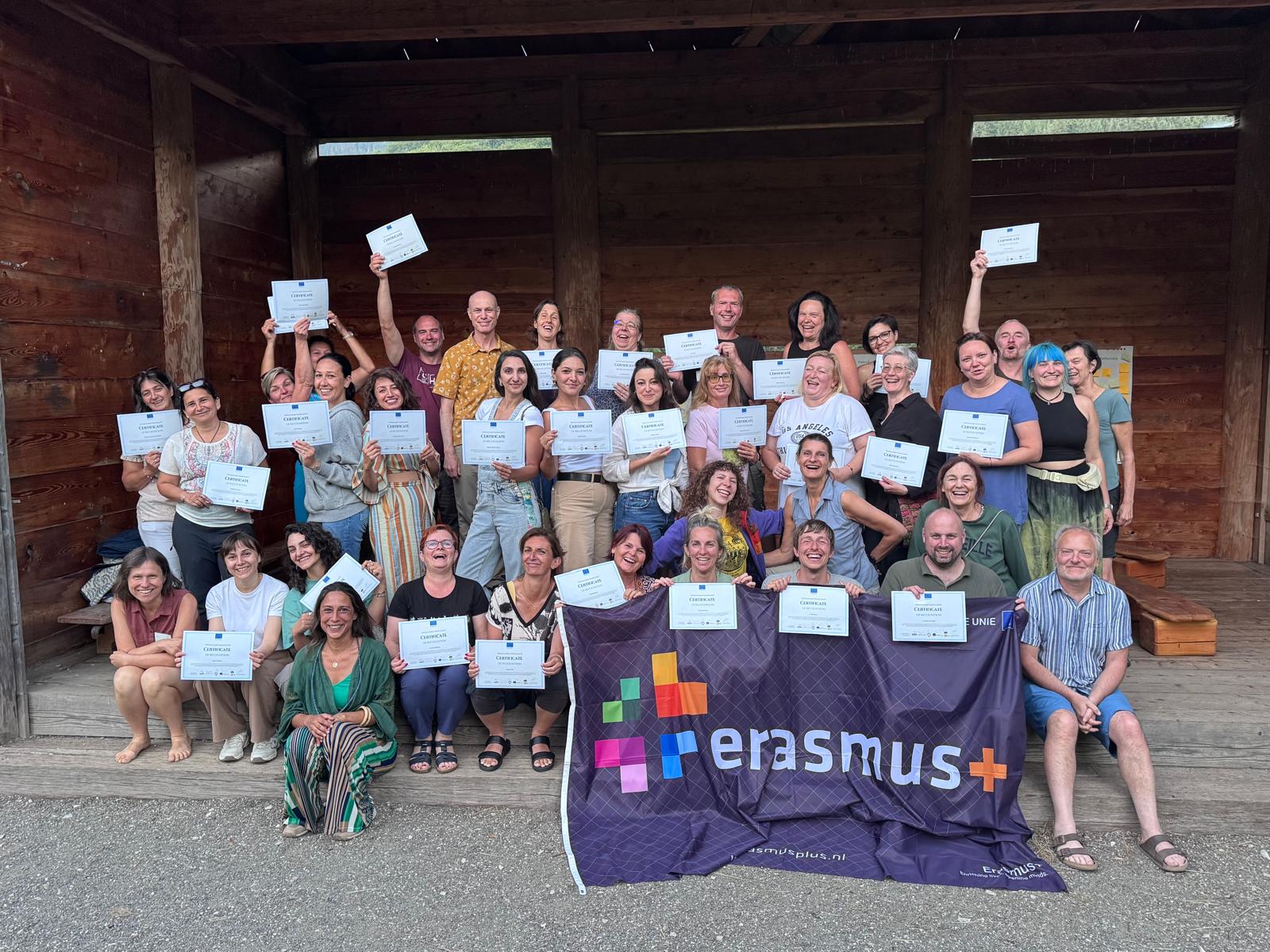
What we discovered is that teachers can readily enrich their teaching of standard curricula with Nature, and achieve the same result as one does with biomimicry in terms of valuing Nature. The four-day gathering of 30 teachers from 5 different countries culminated in teachers showing us how they did just this. The physics teachers, for example, showed us how they could use the example of birds flying in V formation to teach principles of aerodynamics. The chemistry teachers showed us how they could teach about chemical molecular structure using a spaghetti tower design challenge. And the art and design teachers showed us how they could teach about observation and perspective using demonstrations about animal perception. Not only were the teachers more engaged by what they were teaching, but in the end, what students come away with is enhanced learning and academic success, and simultaneously, greater admiration and affection for the natural world. Win-win-win.

The training venue in the town of Horní Maršov (Czechia), built in 1568 (before the advent of modern science, before Newton was born!)

One of the amazing meeting rooms… the teachers are from Czechia, Türkiye, Hungary, Slovakia, and the Netherlands

A chemistry teacher showing off a spaghetti tower inspired by the structure of a polymer; the tower withstood the shake table test (above); A demonstration of the effectiveness of V formations in bird flight (below – click play)


